Choosing Care · 11 min read
Winter depression in Maine: what actually helps beyond a light box
Maine gets less winter daylight than almost any state, and by December most people notice it. For many, that's a mood dip that lifts in spring. For a smaller group, it's Seasonal Affective Disorder, a real form of major depression that shows up on schedule every year and doesn't just wait itself out. Here's what SAD actually is, what a light box can and can't do, and the treatment options with real evidence behind them.
Written under the clinical direction of Shariq Refai, MD, MBA, FAPA, board certified psychiatrist · Last updated October 13, 2026 · Editorial policy

From my practice · Shariq Refai, MD, MBA, FAPA
What I actually tell patients starting a Maine winter
The two mistakes I see most are waiting too long to start and stopping too early. People wait until January when they're already sliding, then hope a light box turns things around in a week. It rarely does. And when March finally warms up, they stop everything, only to be right back in the same spot the next November.
The realistic version is unglamorous: if you've had SAD before, plan for the next winter starting in September. Get the medication conversation done then. Get the light box out in early October. Protect sleep and morning light through the whole stretch. Taper in spring, with a clinician, once you're solidly better. It's a plan, not a battle, and it works better every year you run it.
The short answer
If your mood, energy, and sleep reliably crash every fall and rebound every spring, that's not weakness. It's likely SAD, and it's a form of depression with real diagnostic criteria and real treatments. Bright light therapy is the treatment people know about, but it isn't the only lever and isn't right for everyone.
Maine sits high in latitude, gets more overcast winter days than average, and pushes many people into a stretch where daylight, movement, and social contact all shrink at once. A treatment plan for a Maine winter usually blends light, medication when it's the right fit, therapy, and structure. If any one of those is missing, the others tend to underperform.
What SAD actually is
In DSM-5-TR terms, Seasonal Affective Disorder is major depressive disorder with a seasonal pattern. That means the full picture of depression, not just a low mood: at least two weeks of persistent depressed mood or loss of interest, plus changes in sleep, appetite, energy, concentration, or feelings of worthlessness, showing up at roughly the same time of year for at least two consecutive years and lifting when the season changes.
The winter pattern usually looks like oversleeping rather than insomnia, weight gain rather than loss, and heavy carbohydrate cravings. Fatigue is the loudest symptom for most people. That's different from the classic pattern of unipolar depression, which is part of why SAD is often missed or dismissed as a slump.
Prevalence estimates vary, but roughly 5 percent of U.S. adults meet criteria for SAD, and rates run higher the further north you go. Another 10 to 20 percent experience a milder subsyndromal version, which won't meet the full diagnosis but still costs you months of your year.
Why Maine hits harder
Portland sits at 43.6 degrees north. By comparison, San Diego is at 32.7. That's not a metaphor, it's about 4 hours less winter daylight at Maine's peak darkness than a southern city gets. Aroostook County, at the top of the state, sits higher still and often runs weeks with sunset before 4 PM.
Cloud cover compounds the effect. Maine averages more overcast days between November and March than most states, and even a bright winter morning here often clocks only a fraction of the outdoor light intensity that a summer noon delivers. Your circadian system reads that light gap and shifts, and your mood and energy follow.
The social geometry of a Maine winter matters too. Long commutes on icy roads, fewer outdoor activities, and a natural pull to stay home all reduce the movement and connection that normally protect against depression. Add the stretch of holidays followed by a long, quiet January and February, and the setup is real.
What a light box can and can't do
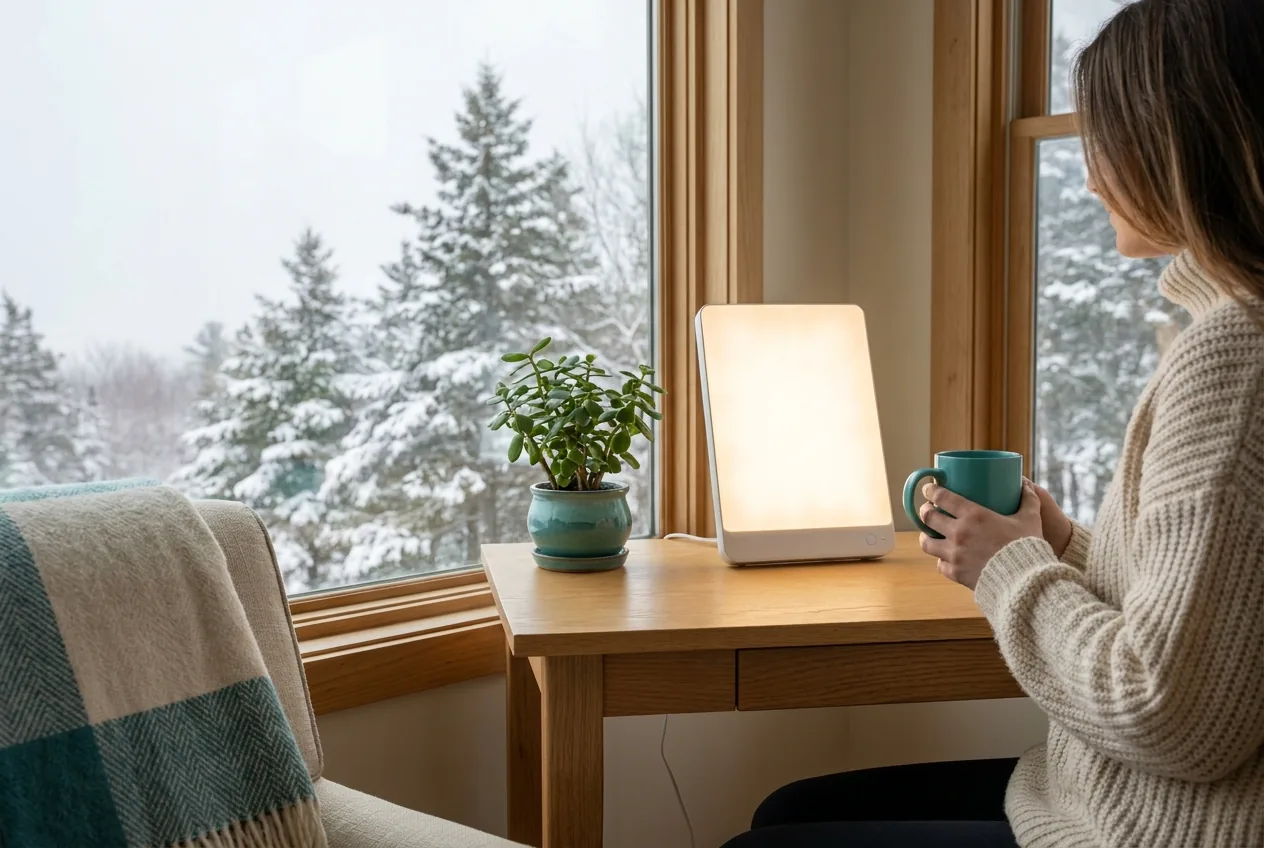
Bright light therapy is a legitimate first-line treatment for SAD. The strongest evidence supports a 10,000 lux full-spectrum light box, used for about 30 minutes within an hour of waking, at a distance where the light hits your eyes at an angle (not staring straight into it). Most people who respond notice a difference within one to two weeks. If you're going to try it, doing it correctly and consistently matters more than owning a fancier model.
It doesn't work for everyone. Response rates in the studies run around 50 to 70 percent for classic winter-pattern SAD, and lower for atypical presentations. It also has side effects worth knowing: eye strain, headache, and, in a minority of people, agitation or a shift into hypomania if there's underlying bipolar spectrum. If your mood becomes wired or you sleep less, stop and check in with a clinician.
It also isn't a replacement for care in more severe presentations. If you're missing work, sleeping through most of the day, having intrusive thoughts about harm, or not eating, a light box isn't enough. That's where a psychiatric evaluation matters.
Beyond light: medication, therapy, and structure
For moderate to severe SAD, or when light alone hasn't done the job, SSRIs (sertraline, escitalopram, fluoxetine) and bupropion have the best evidence. Bupropion has an FDA indication for SAD prevention when started before symptom onset, usually in early fall, and continued through the season. SSRIs tend to be started once symptoms are established. Either way, the medication is a tool inside a plan, not the whole plan.
Cognitive behavioral therapy for SAD (CBT-SAD) is another well-studied option, particularly for people who want to reduce risk of recurrence year over year rather than treat one winter at a time. It targets the specific thought and behavior patterns that keep winter depression going, and there's evidence it lowers relapse rates in future winters more than light therapy alone does.
Structure sounds boring but does more work than most patients expect. Regular wake time, morning outdoor light exposure (even 10 minutes helps), movement most days, protected sleep, and at least one social contact per day are what let the other pieces actually work. In Maine winters, these get harder just when they matter most. Building them into a routine before December is a lot easier than trying to install them in February.
The reset that works for a Maine winter
A practical plan for someone in Maine who's had trouble with winter mood before usually looks like this: start prevention in September, layer in treatment early rather than waiting for a crisis, and build in the checkpoints that catch a slide before it becomes a hole.
When to reach for care
If a light box hasn't helped after two to three weeks of consistent use, or if you're losing time from work, isolating, or having any thoughts of self-harm, that's a psychiatric evaluation, not a lifestyle fix. A full evaluation clarifies whether this is straightforward SAD, unipolar depression that happens to worsen in winter, bipolar spectrum with a seasonal pattern (which changes the treatment), or something else.
Maine's psychiatric access problem is real. Most counties are federally designated mental health provider shortage areas, and waitlists can run months. That's exactly where telepsychiatry fills the gap. A licensed Maine clinician by secure video can do the same evaluation and treatment a local one can, without the two-hour drive.
shrinkMD provides adult telepsychiatry across Maine, from Portland and Bangor to Aroostook County. Full evaluations, non-controlled medication management when appropriate, and coordination with therapy. See the Maine care page, the Seasonal Affective Disorder page, or read the fuller picture in the Maine mental health guide.
Mental health shortage data
Maine's mental health shortage, county by county
12 of Maine's 16 counties have all or part of their area inside a federally designated mental health shortage area. Cumberland, Lincoln, Sagadahoc, and York counties have none.
Highest-scoring active designations (out of 25):
- Piscataquis County: score 19
- Houlton: score 18
- LI-Bethel SA: score 18
See every Maine county on the shortage map · Download the data
Source: HRSA mental health shortage designations, checked September 28, 2026; 2020 Census.
Key takeaways
Five things to remember
- SAD is diagnosable major depression with a seasonal pattern, not just winter blues, and about 5 percent of U.S. adults meet criteria (higher at Maine's latitude).
- Maine's short winter days, overcast weather, and long commutes all compound the mood effect, which is why treatment there often needs more than a light box alone.
- Bright light therapy (10,000 lux, 30 minutes, morning) helps 50 to 70 percent of classic winter SAD but has side effects and isn't right for everyone, including people with bipolar spectrum.
- SSRIs, bupropion (especially preventatively), and CBT-SAD are the evidence-based add-ons when light isn't enough or the presentation is more severe.
- Start the plan in September, protect wake time and morning light in October, and get a full psychiatric evaluation if symptoms are missing work or safety is a concern.
Go deeper across The Shrink Network
You are here: shrinkMD, the clinical care layer of The Shrink Network.
Each site in the network has one job. No matter where you enter, we help you find the next step that makes sense.
Want to understand more first?
- DepressionResource: Light therapy for depression
- Shrinkopedia: Seasonal affective disorder (encyclopedia)
- DepressionResource: The seasonal depression map
These sites and shrinkMD are part of The Shrink Network, founded by Shariq Refai, MD.
Keep exploring
Keep reading, or take the next step
Frequently asked questions
Good questions, clear answers
Is winter depression in Maine really different from other places?
Yes and no. The diagnosis is the same, but Maine's latitude and cloud cover produce a bigger daylight drop than most states, and the isolation of a long rural winter magnifies the effect. Rates of SAD run higher the further north you go.
How long until a light box helps?
If it's going to work for you, you usually notice a difference within one to two weeks of consistent daily use. If you're at three weeks with no change, or you feel wired or sleep less, that's a signal to reassess with a clinician rather than push harder.
Do I need a prescription for a light box?
No. 10,000 lux full-spectrum boxes are sold over the counter. Fit and consistency matter more than brand. Avoid boxes without a proper lux rating or ones marketed for tanning.
Should I try Vitamin D?
It's reasonable to test your level and treat a deficiency, which is common in Maine. Vitamin D supplementation alone hasn't shown consistent antidepressant effects in trials, but a real deficiency is worth correcting for many reasons. Talk to your primary care clinician about testing.
What if a light box doesn't help?
Move to a full evaluation. That usually means an SSRI or bupropion, CBT-SAD when available, and a check for anything else going on (thyroid, sleep apnea, bipolar spectrum, iron, or grief). Light alone is a first-line tool, not the only tool.
Can telepsychiatry help with SAD if I'm in rural Maine?
Yes. A licensed Maine clinician by secure video can do the same evaluation and treatment as an in-person one, and it removes the winter driving problem. shrinkMD is one option; ask any Maine telepsychiatry practice about their approach to SAD specifically.
When should I go to the ER instead?
If you're having active thoughts of suicide with intent or a plan, or you can't keep yourself safe, that's the ER or 988. SAD can escalate faster than people expect, and severe depression is a medical emergency, not a matter of pushing through.
Sources
Sources and further reading
- NIMH: Seasonal Affective Disorder
- American Psychiatric Association: Seasonal Affective Disorder overview
- Maine DHHS: Behavioral Health
- 988 Suicide and Crisis Lifeline
- Cochrane Review: Light therapy for preventing seasonal affective disorder (Nussbaumer-Streit et al., 2019)
- Cochrane Review: Second-generation antidepressants for prevention of seasonal affective disorder (Gartlehner et al., 2019)
About the author
Shariq Refai, MD, MBA, FAPA
I'm a board certified psychiatrist and the founder of shrinkMD, a telepsychiatry platform built around access, continuity, and clinical rigor. My work focuses on helping people understand their mental health clearly and thoughtfully, without rushing to conclusions or shortcuts. I have clinical experience across a range of settings, including work with high-performing individuals and professional athletes, and I remain committed to care that's careful, individualized, and grounded in sound clinical judgment. shrinkMD provides psychiatric care across multiple licensed states in the US, with an emphasis on responsible telepsychiatry and long-term continuity.
Questions like these deserve a real evaluation
shrinkMD is opening first in Maine and Nebraska. Join the waitlist and we'll email you when booking opens in your state.
Join Our Waiting List