Sports & Performance · 8 min read
Championship Pressure: What Elite Athletes Carry Before the Big Game
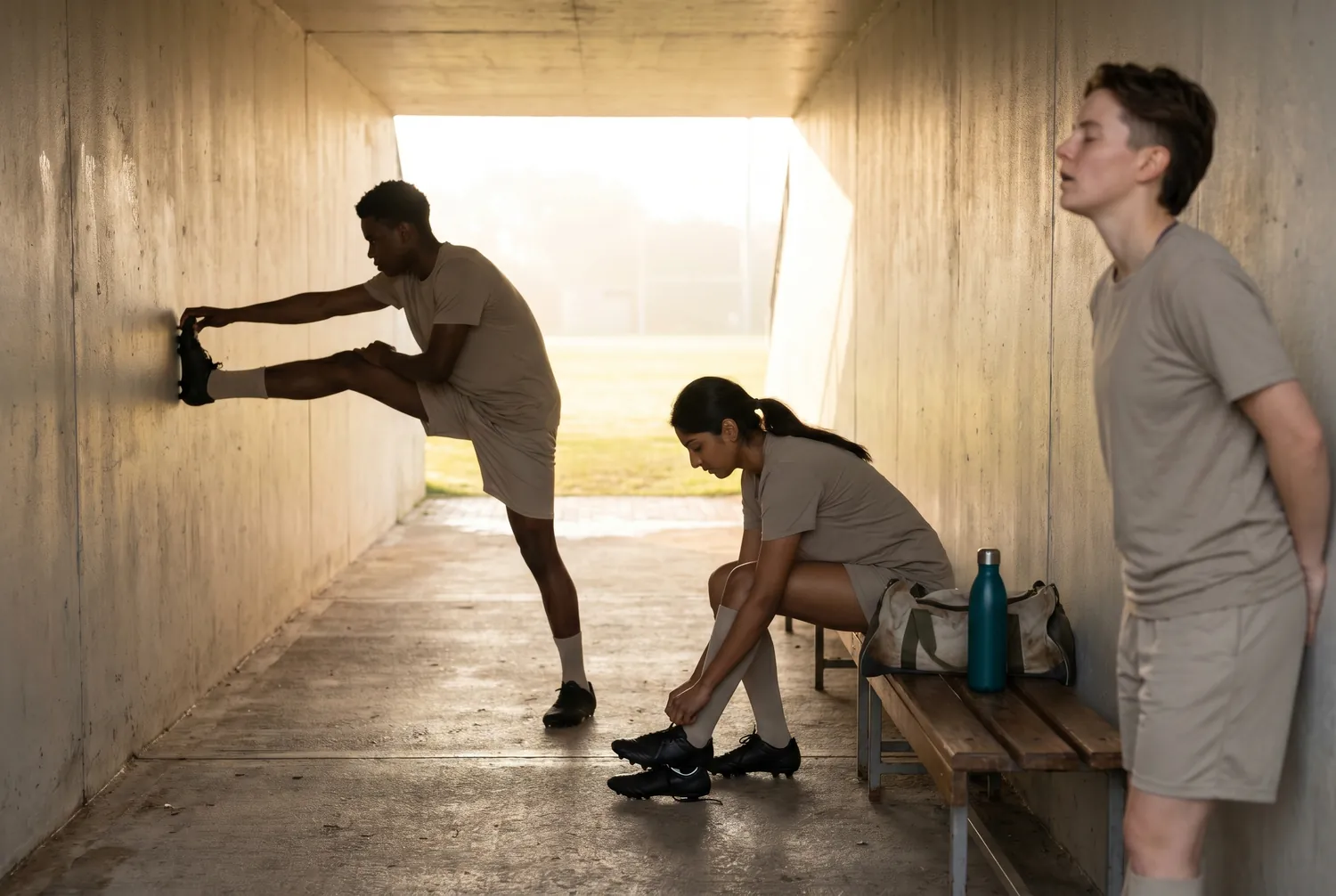
The week before a championship looks loud from the outside, interviews, predictions, cameras everywhere. Inside the locker room it's strangely quiet: light sleep, looping thoughts, a tight chest that won't quite release. As a psychiatrist who works with high performers, I can tell you pressure rarely shows up as panic. It builds quietly, and carrying it well is a skill anyone can learn.
Medically reviewed by Shariq Refai, MD, MBA, FAPA, board certified psychiatrist · Last reviewed September 23, 2026 · Updated October 24, 2026 · Editorial policy

From my practice · Shariq Refai, MD, MBA, FAPA
What championship pressure does up close
Working with high performers, I've seen what championship pressure actually does, and it isn't what fans imagine. The best athletes aren't fearless. They've simply built a relationship with fear that lets them perform alongside it. The ones who struggle are often the ones who believe they should feel nothing.
The damage usually comes from the story that any anxiety means weakness, because that story drives it underground where it festers. What I work on with elite performers is the same thing I work on with everyone else: not eliminating the pressure, but changing how they carry it. The stakes are higher, the principle is identical.
The quiet week before the big game
From the outside, championship week is nonstop spectacle: media day, endless predictions, old plays replayed as if they happened yesterday. Inside, it feels very different. There's waiting, stillness between practices, and long hotel nights when sleep comes lightly. The mind runs ahead to moments that haven't happened yet, a third down, a missed assignment, a chance that may never come again.
Pressure at this level rarely announces itself as panic. More often it sits just under the surface: a tight chest, a shorter fuse, a sense that every detail suddenly matters more than ever. Veterans aren't immune. The more someone understands what's at stake, the heavier that awareness can feel, past games linger as emotional memory, not highlight reels.
This is where sports psychiatry becomes useful, not as a performance trick, but as a way of understanding what's happening internally. Elite competition puts identity, self-worth, and emotional regulation under a microscope. The goal isn't to eliminate pressure; that would be unrealistic. The goal is to learn to stay grounded while carrying it.
Pressure accumulates long before kickoff
Pressure doesn't arrive all at once. It builds for weeks, sometimes months, as the game becomes a fixed point everything else orbits. Sleep is often the first thing to go, not because the body isn't tired, but because the mind won't fully shut off. Some athletes over-prepare, staying late and re-running scenarios that are already well rehearsed. On the surface it looks like dedication; underneath it's often anxiety trying to regain a sense of control.
One of the heaviest loads at this level is identity. When performance becomes tightly linked to self-worth, every moment starts to feel evaluative. A good practice reassures; a bad one lingers. The line between who you're and how you play can blur. That isn't a character flaw, it's a very human response to environments where outcomes are public and judgment is constant.
This is also where the idea of mental toughness gets distorted. Many people imagine toughness as ignoring emotions and pushing through no matter what. In practice, suppressed stress doesn't disappear; it shows up elsewhere, in tension, distraction, poor sleep, or reactivity. Real resilience means noticing what's happening internally and responding with intention rather than force.
Anxiety isn't the enemy
Anxiety has a bad reputation in elite sports, as if feeling nervous means something has already gone wrong. In reality, anxiety is information. It's the nervous system signaling that something meaningful is happening. Managed well, that activation sharpens focus, quickens reactions, and keeps an athlete locked into the moment instead of drifting away from it.
Problems arise when activation tips into overwhelm: thoughts speed up, muscles tighten, and decision-making becomes rigid or rushed. The same system that enhances performance starts to interfere with it. The difference isn't the presence of anxiety but how it's interpreted and regulated.
Telling yourself to stop feeling nervous rarely works, it usually adds another layer of self-monitoring and tension. A healthier approach is acknowledgement without alarm: noticing anxiety, allowing it to be there, and working with it rather than against it. Calm doesn't come from suppression. It comes from understanding what the body is doing and responding deliberately.
Common myths about mental toughness
Myth: toughness means never feeling anxious. The athletes who perform well under pressure aren't the ones who feel nothing, they're the ones who regulate what they feel instead of fighting it or pretending it isn't there. Anxiety before high stakes is a normal response, not a flaw.
Myth: pressure only affects rookies, and elite performers don't need help. Often the opposite is true. Experience brings awareness, and awareness brings weight, veterans know how rare these moments are and what they can mean for a legacy. Many professionals work with mental health clinicians proactively, to stay focused and durable over time, not because something is wrong.
Myth: strong athletes should handle it alone. Elite athletes are surrounded by coaches, trainers, and teammates for a reason, and mental health is no different. Using support effectively is often exactly what allows someone to keep performing at a high level. Help is part of the system, not an admission of failure.
What high performers actually do
When pressure is high, the most effective athletes don't try to do more, they do less, more deliberately. They narrow attention to what's controllable: preparation has already happened, skills are already there, so energy spent on outcomes, referees, or narratives is energy taken from execution. The next play, the next breath, the next assignment. Simple doesn't mean easy; it means disciplined.
Presence matters more than perfection. Mistakes happen at every level; the difference is how quickly someone resets and returns to the moment instead of mentally replaying what already passed. Athletes also learn to notice when attention drifts toward win-or-lose scenarios and gently bring it back, by habit, not force, practiced long before the championship arrives.
Routines and recovery do quiet, powerful work. Consistent pre-game habits, breathing, stretching, the same warm-up sequence, the same music, give the nervous system something familiar to anchor to. And recovery is treated as part of performance, not a reward earned afterward: sleep, downtime, and mental breaks are protected because pushing constantly without rest erodes resilience rather than building it.
Practical strategies before big moments
Slow, intentional breathing is the most reliable tool. Lengthening the exhale by even a few seconds signals the body that it's safe to settle. Visualization helps too, not imagining perfect outcomes, but rehearsing composure: responding calmly after a mistake, returning attention after a distraction. The goal is familiarity with calm, so the nervous system can find its way back to it.
Athletes also protect sleep with consistent schedules and less late-night stimulation, set boundaries around media and commentary that amplify self-doubt, and use grounding in quiet moments, naming five things you can see, four you can feel, three you can hear, two you can smell, one you can taste. Brief journaling about process wins (effort given, focus maintained, recovery honored) helps detach identity from outcomes.
There's also a line between manageable stress and strain that deserves professional attention. Persistent irritability, ongoing sleep disruption, emotional numbness, or trouble concentrating despite solid preparation are signals the load may be too heavy to carry alone. At that point a thoughtful psychiatric evaluation is a responsible response, not a failure.
What the rest of us can learn
The pressure athletes feel before a championship isn't as foreign as it looks. High-stakes meetings, major presentations, career-defining decisions, the nervous system doesn't measure importance by stadium size; it responds to meaning. The most protective lesson athletes learn is separating identity from outcome: your value doesn't hinge on one deal, one exam, or one moment going perfectly.
Athletes who last respond to rising stress by adding structure, rest, and support rather than stripping those things away. For everyone else, that might mean protecting sleep during busy weeks, simplifying decisions, or building small routines that provide stability. Seeking support isn't a concession, it's a strategy.
When pressure starts to spill into sleep, mood, or focus, discreet psychiatric care can help without disrupting training or work. shrinkMD offers telepsychiatry for adults 18 and older (pre-launch and taking waitlist sign-ups), with flat published fees, see how it works. If you're in crisis, call or text 988, or call 911 for an emergency.
Key takeaways
Five things to remember
- Championship pressure rarely shows up as panic; it builds quietly through light sleep, looping thoughts, and tension in the weeks beforehand.
- Anxiety is information from the nervous system, and regulated well it sharpens focus rather than signaling that something has gone wrong.
- Real toughness means noticing internal states and responding with intention, because suppressed stress resurfaces as tension, distraction, or poor sleep.
- High performers narrow attention to controllables, lean on familiar pre-game routines, and treat sleep and recovery as part of performance.
- Persistent irritability, ongoing sleep disruption, numbness, or trouble concentrating despite solid preparation are signals to seek a psychiatric evaluation.
Go deeper across The Shrink Network
You are here: shrinkMD, the clinical care layer of The Shrink Network.
Each site in the network has one job. No matter where you enter, we help you find the next step that makes sense.
Want to understand more first?
- ShrinkDaily: Performance anxiety
- Shrinkopedia: The Yerkes-Dodson curve
- AnxietyResource: High-performer anxiety map
These sites and shrinkMD are part of The Shrink Network, founded by Shariq Refai, MD.
Keep exploring
Keep reading, or take the next step
Frequently asked questions
Good questions, clear answers
Is performance anxiety normal for elite athletes?
Yes. Performance anxiety is a natural response to high stakes and high meaning. Understood and regulated, it can sharpen focus and readiness; ignored or fought, it can become overwhelming. The goal isn't to eliminate anxiety but to work with it so it supports performance rather than disrupting it.
How do I know if pressure is turning into something more serious?
Watch for symptoms that persist beyond the moment itself: ongoing sleep disruption, irritability that carries into daily life, emotional numbness, or difficulty concentrating despite solid preparation. If these patterns last more than a week or two, a professional evaluation can clarify what's happening and what support might help.
Can seeking psychiatric help hurt an athlete's career?
No. Modern sports psychiatry is built around discretion and confidentiality. Many professional athletes use psychiatric support proactively to improve emotional regulation, resilience, and recovery. It isn't a last resort, it's often part of staying durable under sustained pressure.
What's the difference between sports psychology and sports psychiatry?
Sports psychology focuses on mental skills like focus, confidence, and routines. Sports psychiatry includes that perspective while adding full medical evaluation, diagnosis of underlying conditions when present, and thoughtful medication management when appropriate. (shrinkMD doesn't prescribe controlled substances such as stimulants or benzodiazepines.) The two disciplines often complement each other.
How can telepsychiatry help during intense training weeks?
Telepsychiatry offers flexibility and privacy. Short virtual sessions fit demanding schedules without travel or disruption, and provide objective perspective during critical periods like playoff runs, while maintaining discretion for high-profile individuals.
Do championship veterans feel less pressure than rookies?
Often it's the opposite. Experience brings awareness of how rare these moments are and what they can mean for a career or legacy. That awareness can intensify pressure, which makes emotional regulation just as important later in a career, if not more so.
What's one quick tool that helps right before a big moment?
Box breathing: inhale for four seconds, hold for four, exhale for four, hold for four. It calms the nervous system quickly. A brief body scan to release tension in the jaw, shoulders, and hands also helps reset focus.
Is it okay to feel anxious and still perform well?
Absolutely. Many elite performers learn to reinterpret anxiety as energy or readiness rather than danger. Acknowledging anxiety without judging it often keeps it from escalating. Feeling anxious and performing well aren't mutually exclusive, they coexist at the highest levels.
How this page is reviewed and how to cite it
EducationalVerify independently: ORCID · Wikidata · NPI Registry · All shrinkMD credentials
shrinkMD. (2026). Championship Pressure & Athlete Mental Health [Web page, medically reviewed by Shariq Refai, MD, MBA]. https://shrinkmd.com/super-bowl-pressure-athlete-mental-healthAbout the author
Shariq Refai, MD, MBA, FAPA
I'm a board certified psychiatrist and the founder of shrinkMD, a telepsychiatry platform built around access, continuity, and clinical rigor. My work focuses on helping people understand their mental health clearly and thoughtfully, without rushing to conclusions or shortcuts. I have clinical experience across a range of settings, including work with high-performing individuals and professional athletes, and I remain committed to care that's careful, individualized, and grounded in sound clinical judgment. shrinkMD provides psychiatric care across multiple licensed states in the US, with an emphasis on responsible telepsychiatry and long-term continuity.
Questions like these deserve a real evaluation
shrinkMD isn't seeing patients yet and hasn't set an opening date. Join the waitlist and we'll email you when booking opens in your state.
Join Our Waiting List